
ControlyourWealth.ca Alternatives for US Entrepreneurs


COMPLIANCE NOTE: For educational purposes only. Not financial, tax, or legal advice.
For US-based entrepreneurs, real estate investors, and high-income earners, Infinite Banking via dividend-paying whole life insurance is the primary alternative worth evaluating when controlyourwealth.ca’s service model does not fit your needs. The Infinite Banker specializes in this approach, offering practitioner-led consulting, policy design, and implementation support tailored to capital efficiency and long-term liquidity.
Three differentiators that matter to this audience:
Liquidity access on your terms. A properly structured whole life policy may allow you to borrow against cash value without liquidating positions or triggering a taxable event, though policy loans accrue interest and reduce cash value and death benefit if unpaid.
Capital efficiency over time. The policy is designed to accumulate cash value that can be recycled into business or real estate deals, not locked in a brokerage account subject to market swings.
Practitioner-led structure. Policy design matters enormously. An Authorized IBC Practitioner structures the policy for maximum early cash value, not maximum commission.
Dividends on whole life policies are not guaranteed. Policy loans accrue interest and reduce cash value and death benefit if unpaid. Policies can lapse if not properly funded and managed.
Table of Contents
What does controlyourwealth.ca actually offer, and how does it compare?
ControlyourWealth.ca presents as an advisor-led financial education and planning platform, primarily serving Canadian clients with content on budgeting, debt management, and investment strategy. For US readers, that creates an immediate mismatch: the platform’s regulatory framework, currency, and product access are Canadian, not American. Before evaluating any alternative, map what you actually need to a recognized US service model.
Quick alignment checklist:
Do you need a fiduciary advisor registered with the SEC or a state regulator?
Are you looking for managed investment portfolios, or a personal banking and liquidity system?
Do you require access to private markets and alternative investments?
Is your priority budgeting software, or a capital strategy for a business or real estate portfolio?
Red flags when evaluating any replacement:
Fees are described vaguely (e.g., “low cost” with no dollar or percentage disclosure)
The provider cannot confirm fiduciary status in writing
Alternatives access is mentioned but redemption terms and valuation methods are not documented
A numbered checklist for comparing providers:
Confirm the provider’s regulatory status (RIA, broker-dealer, insurance-licensed, or unregistered coach)
Request a written fee schedule before any engagement
Ask specifically how liquidity is handled for each product offered
Verify whether the provider has a documented conflict-of-interest policy
Which service model fits your situation?
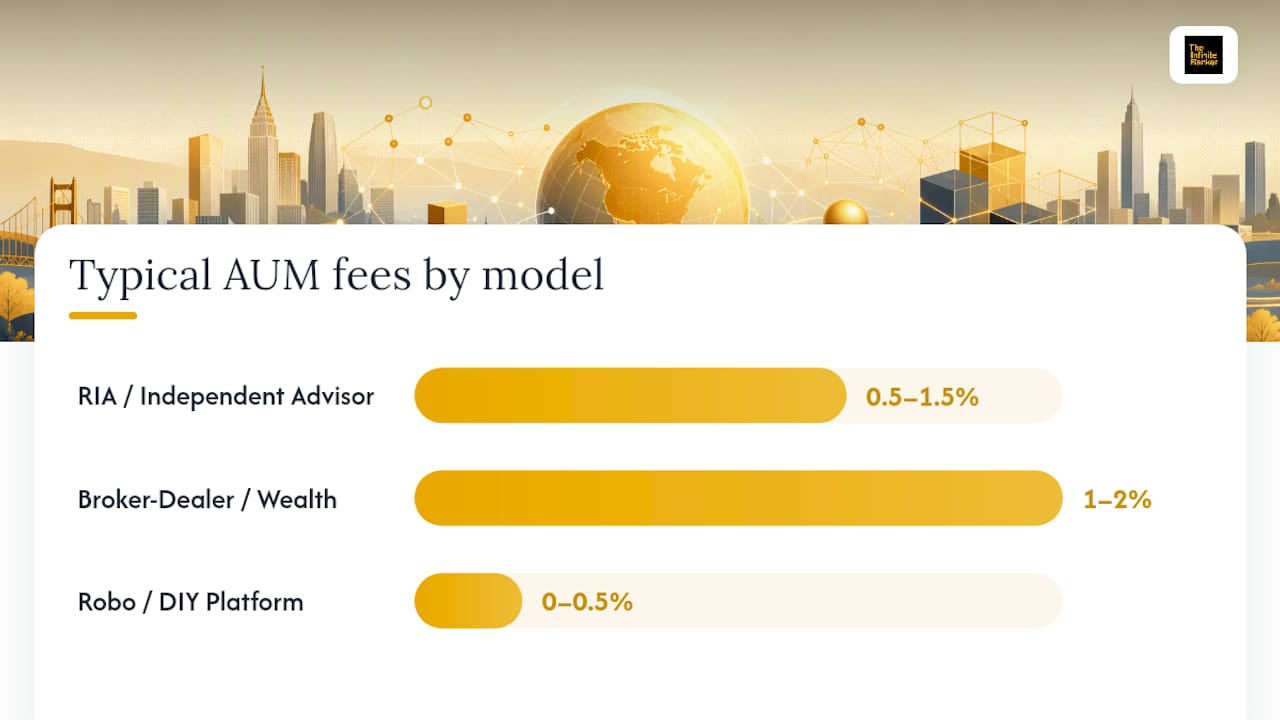
Six models cover the realistic alternatives for US entrepreneurs and high earners. Each has a distinct fee structure, regulatory status, and liquidity profile.
Dimension | RIA/Independent Advisor | Broker-Dealer/Private Wealth | Robo/DIY Platform | Financial Planner/Coach | Infinite Banking (Whole Life) | Hybrid Platform |
Service model | Managed/advisory | Managed/advisory | DIY | Advisory/educational | Insurance-based | Managed + tools |
Fees | 0.5%–1.5% AUM | 1%–2% AUM + product commissions | 0%–0.5% AUM | Flat or hourly | Commission on policy | Tiered AUM + flat |
Minimums | — | — | $0–$5K | None to modest | Varies by policy size | — |
Alternatives access | Moderate | High | Low | None | Indirect | Moderate to high |
Liquidity | High (public markets) | Moderate (lock-ups vary) | High | N/A | Policy loan mechanics | Moderate |
Fiduciary status | Yes (RIA) | Suitability standard | Varies | Varies | State insurance regulation | Varies |
Ideal client | Accredited investors | Ultra-high-net-worth | Self-directed savers | Budget-focused individuals | Entrepreneurs, RE investors | Growing HNW clients |
According to Mercer’s 2025 research, 92% of advisors already allocate to alternatives and 91% plan to increase those allocations over the next two years, which signals that access to private markets is becoming a baseline expectation rather than a premium feature. BNY research reinforces that there is no one-size-fits-all approach: liquid versus illiquid strategies should be selected based on individual client liquidity needs and objectives.
For DIY-oriented readers, Forbes identifies leading budgeting apps including YNAB, Monarch Money, PocketGuard, and Quicken Simplifi as the primary personal finance software options. UseKYN represents a newer privacy-first category, using on-device anonymized AI to translate finances into plain-dollar metrics. These tools serve a different job than an advisor or an Infinite Banking policy, but they are worth knowing for readers whose primary need is cash flow visibility rather than capital strategy.
How does Infinite Banking compare on the key dimensions?
Infinite Banking, implemented through a dividend-paying whole life policy, does not function like a brokerage account or a managed portfolio. Understanding the mechanics prevents mismatched expectations.
Feature-by-feature comparison:
Fees/compensation. The practitioner earns a commission on policy placement. There are no ongoing AUM fees. Total policy costs are embedded in the premium structure and vary by insurer and policy design.
Minimums. Policies can be structured at various funding levels, but meaningful early cash value typically requires a committed annual premium. Discuss specific funding profiles with an Authorized IBC Practitioner.
Alternatives access. Indirect. The policy itself is not an investment vehicle for stocks or private funds. Cash value accessed via policy loans can be deployed into real estate, business capital, or other investments at the policyholder’s discretion.
Liquidity. Policy loans are available without credit checks or mandatory repayment schedules, but they accrue interest and reduce the death benefit and cash value if unpaid. Surrender of the policy in early years typically results in a loss relative to premiums paid.
Regulatory status. Whole life insurance is regulated by state insurance commissioners, not the SEC or FINRA. This means SIPC protections do not apply. Insurer financial strength ratings (A.M. Best, Moody’s) are the relevant quality indicator.
Implementation timeline:
Initial strategy consultation with an Authorized IBC Practitioner (1–2 weeks to schedule and complete)
Policy design and carrier selection (1–2 weeks)
Underwriting and medical review (2–6 weeks, depending on health and coverage amount)
Policy issue and first premium payment
Cash value begins accumulating; meaningful borrowable cash value typically develops over the first 2–3 years depending on funding level and policy structure
Pro Tip: Before committing to any whole life policy for Infinite Banking, ask the practitioner to show you the policy illustration with the paid-up additions (PUA) rider clearly labeled, the projected cash value at years 1, 5, and 10, and the dividend history of the issuing carrier. Dividends are not guaranteed, but a carrier’s long-term dividend track record is a meaningful signal of policy performance.
For a deeper look at how whole life policies function over long horizons, see how whole life policies support generational wealth planning.
How do you evaluate any alternative provider?
Start with binary criteria before spending time on deeper due diligence.
Immediate yes/no criteria:
Is the advisor or platform registered as an RIA with the SEC or a state regulator, or licensed as an insurance professional in your state?
Is the fee schedule available in writing before any engagement?
Does the provider disclose conflicts of interest (e.g., product commissions, revenue sharing)?
Specific questions to ask:
How do you get paid, and what are the total fees I will pay in year one and year five?
What is your fiduciary or suitability standard, and can you provide that in writing?
How is liquidity handled if I need capital quickly?
What alternative investments do you offer, and how are they valued between reporting periods?
What is the minimum commitment, and what are the penalties for early exit?
Red flags:
Inability to produce a sample account statement or policy illustration on request
Vague answers about redemption terms for illiquid products
Pressure to commit before reviewing all documents
Altruist notes that alternative investments are speculative, often illiquid, can lose principal, and typically lack daily pricing transparency. That caution applies whether you are evaluating a private equity fund through an RIA or a non-traditional insurance product. For a structured checklist aligned to high earners, the wealth preservation strategies checklist on The Infinite Banker’s site is a practical starting point.
What do costs and timelines look like in practice?
Advisory transition (RIA or broker-dealer):
AUM fees typically range from 0.5% to 1.5% annually, depending on account size and service scope
Flat financial planning fees vary widely by advisor and scope of engagement
Transfer timelines: ACAT transfers between custodians typically complete in 5–7 business days; full advisor onboarding, including discovery and plan delivery, often takes 4–8 weeks
Infinite Banking policy implementation:
Consultation and policy design: 2–4 weeks
Underwriting: 2–6 weeks (standard health; longer for complex cases)
Policy issue and first premium: typically 6–10 weeks from initial consult
Usable cash value: meaningful borrowable value generally develops over years 1–3, depending on funding level
Morgan Stanley research notes that alternatives can offer diversification benefits but involve higher fees and valuation complexity. Celent’s research highlights that wealth managers are increasingly adopting simplified operational tools to scale alternative access, precisely because the due diligence burden is real.
Involve your CPA and estate attorney before switching advisory relationships or implementing a new policy. An Authorized IBC Practitioner such as Jib Hunt can coordinate with your existing advisors on the insurance side.
What US regulatory and risk factors should you know?
Key regulatory distinctions:
RIAs are registered with the SEC (assets over $100 million) or state regulators and are held to a fiduciary standard
Broker-dealers are regulated by FINRA and typically held to a suitability standard, not a fiduciary one
Insurance products, including whole life, are regulated by state insurance commissioners; no SIPC or FDIC protection applies
Many private alternative investments require accredited investor status ($1 million net worth excluding primary residence, or $200K+ annual income)
Valuation and liquidity risks:
Illiquid alternatives often use periodic, not daily, valuations; reported values may not reflect what you would receive on a forced sale
Policy surrender in early years typically returns less than total premiums paid
Private fund capital calls can create cash flow pressure if not planned for
Pro Tip: Before investing in any alternative through an advisor, verify the advisor’s RIA or broker-dealer registration on the SEC’s Investment Adviser Public Disclosure database (IAPD) or FINRA BrokerCheck. For a whole life policy, check the issuing carrier’s A.M. Best rating; a rating of A or better is a reasonable baseline.
Key Takeaways
For US entrepreneurs and high-income earners, the right alternative to controlyourwealth.ca depends on whether you need a managed portfolio, a personal banking system, or a DIY budgeting tool.
Point | Details |
Map your need first | Identify whether you need fiduciary advice, a liquidity system, or budgeting software before comparing providers. |
Fiduciary vs. suitability | RIAs are held to a fiduciary standard; broker-dealers operate under a suitability standard. Confirm in writing. |
Alternatives carry real risk | Per Altruist, alternatives are speculative, often illiquid, and may lack daily pricing transparency. |
Advisor adoption is rising | Mercer found that 92% of advisors already allocate to alternatives and 91% plan to increase those allocations over the next two years. |
The Infinite Banker | For entrepreneurs and real estate investors seeking a personal banking system, The Infinite Banker offers practitioner-led Infinite Banking consulting and policy design. |
Why Infinite Banking deserves a closer look than most comparisons give it
Most wealth management comparisons treat Infinite Banking as a niche insurance product and move on. That framing misses the point for a specific type of client: the entrepreneur or real estate investor who needs capital that is accessible, not correlated to public markets, and not subject to a lender’s approval process.
The conventional critique of whole life insurance, that it is expensive and slow to accumulate value, is accurate for policies designed to maximize death benefit. It is far less accurate for policies designed with paid-up additions riders and structured for early cash value. The design matters more than the product category.
What most comparisons also skip is the operational reality of alternatives access through an RIA or broker-dealer. Getting into a private credit fund or a real estate syndication through a traditional advisor involves accreditation verification, subscription documents, capital call schedules, and lock-up periods that can run three to seven years. A policy loan, by contrast, is available in days with no credit check and no mandatory repayment timeline, though the interest cost and impact on cash value and death benefit are real and should be modeled carefully.

The honest caveat is that Infinite Banking is not a replacement for a diversified investment portfolio. It is a liquidity and capital management layer that works alongside other strategies. Entrepreneurs who use it most effectively tend to treat the policy as a financing tool, not a savings account.
The Infinite Banker: consulting and next steps
The Infinite Banker works with entrepreneurs, real estate investors, and high-income earners who want a properly structured whole life policy designed for capital efficiency, not just death benefit coverage. The consulting process covers policy design, carrier selection, underwriting guidance, and ongoing education on how to use policy loans effectively within a broader financial strategy.
If you are evaluating whether Infinite Banking fits your situation, start with the Infinite Banking calculator to model funding levels and projected cash value. To understand which client profiles this approach is designed for, the who Infinite Banking is for page gives a direct answer. When you are ready to discuss a specific policy structure, schedule a consult with Jib Hunt, an Authorized IBC Practitioner, directly through the site.
Dividends are not guaranteed. Policy loans accrue interest and reduce cash value and death benefit if unpaid. Policies can lapse if not properly funded.
Useful sources and further reading
The State of Alternative Investments in Wealth Management 2025
Alternative Investments: Key Wealth Trends & Insights
Alternative Investments — Altruist
Portfolio Strategies | Morgan Stanley
Embracing Alternatives in Wealth Management | Celent
UseKYN | Personal Finance App — Real Dollars, Plain English | Monarch, YNAB & Rocket Money Alternative
Best budgeting apps — Forbes
Related reading on The Infinite Banker:
This post is educational only and not financial, tax, or legal advice. Consult qualified professionals before acting.
Recommended
Comments